Circular economy testbed and anaerobic digestion modelling
Why it matters
Organic waste such as food waste and crop residue can be turned into biogas by anaerobic digestion, so that it becomes energy rather than landfill. A university campus is a useful place to show this at working scale: it generates organic waste, it needs energy, and it can bring engineering, economics and policy together around one site.
The problem
Deciding whether a digestion plant is worth building depends on feedstock supply, site, cost and regulation, and on how fast and how completely a given feedstock digests. The last of these is usually measured in small batch tests, which do not by themselves say how a continuous full-scale digester would perform.
What we do
- Testbed scoping. Assess possible locations for a circular economy testbed on Curtin campuses, working from published guidance on digester feasibility and cost, food waste baselines, and national waste policy and reporting.
- Digestion modelling. Develop and maintain a MATLAB program that describes the digestion of a feedstock with mass balances on cells, dead cells, substrate, nutrients and water, and Monod-type growth kinetics.
Approach
The program has three modes, selected from an Excel input sheet:
- Experimental data fit. Takes methane production from a batch test and finds the best-fit maximum growth rate and half-velocity constant.
- Batch simulator. Predicts a batch run from those parameters.
- Continuous digester simulator. Predicts a continuously fed digester from the same parameters.
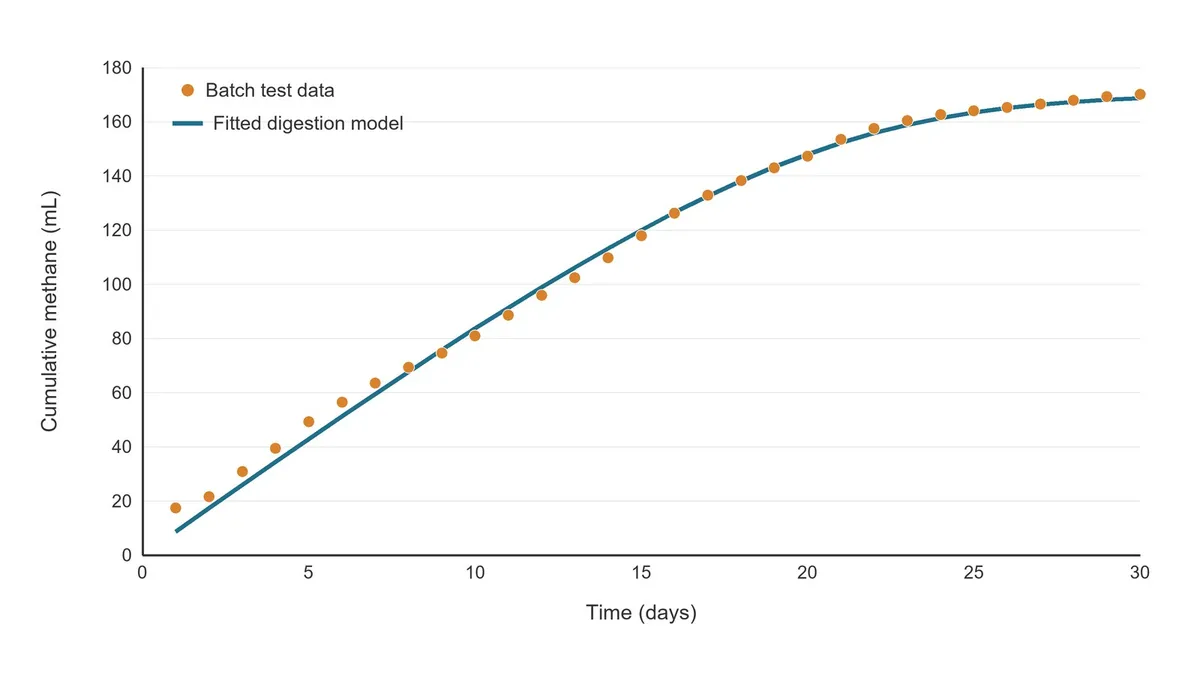
The image above shows the fit mode on a 30-day batch test of a bagasse feedstock. Fitting on small tests and then simulating the continuous case is intended to give a quick, low-cost check on feedstock and operating choices before any plant is built.
Outputs
An internal MATLAB modelling tool with a written user guide. No publications from this work are listed on the site yet.
Collaborators
Curtin University (chemical engineering).
Contact
For collaboration or student projects in anaerobic digestion, biogas and waste-to-value modelling, contact the SMILE lab.