Techno-economics of liquid organic hydrogen carriers
Why it matters
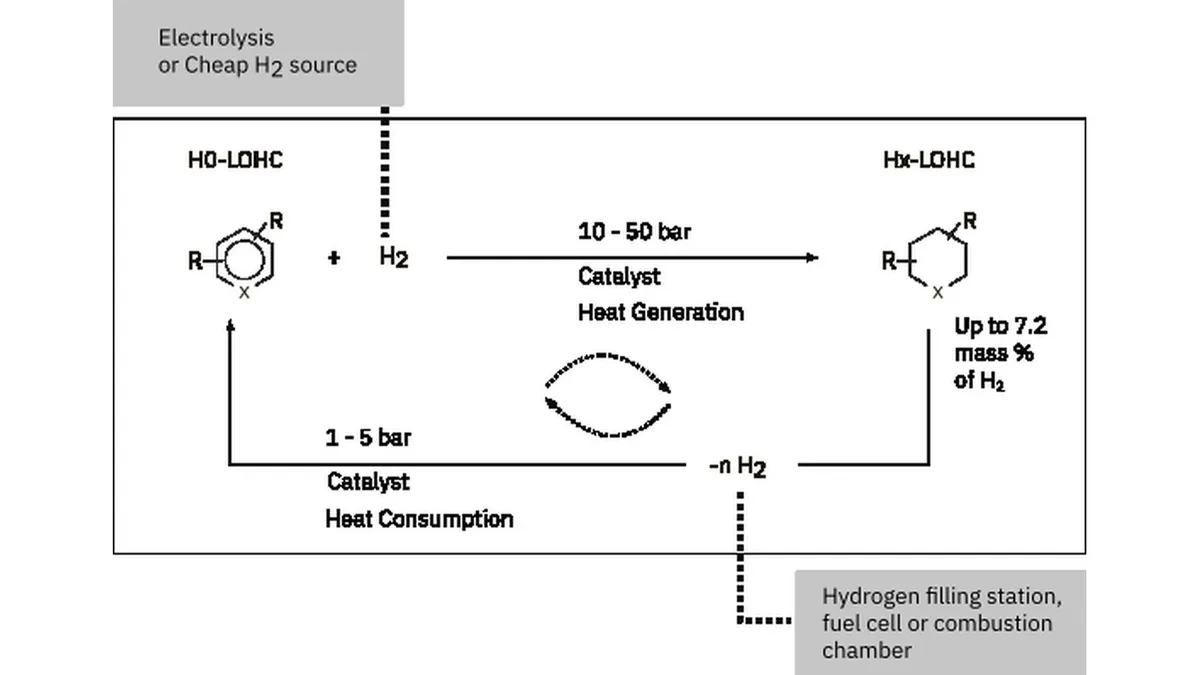
Moving hydrogen over long distances is expensive. Liquid organic hydrogen carriers bind hydrogen chemically to a liquid that can be stored and shipped under ambient conditions with existing infrastructure. Dibenzyltoluene is a technically mature example. Whether it competes depends on the whole chain, not on any one step.
The problem
Hydrogenation catalyst choice is usually judged on activity and material price. Its effect on the rest of the system, such as reactor size, compression, carrier degradation and replacement, is less clear, and it is hard to compare options without a consistent cost model.
What we do
We assess the dibenzyltoluene carrier at system level, holding the dehydrogenation conditions fixed so that differences come from the hydrogenation step. Nickel, ruthenium and platinum catalysts are compared, and the result is set against liquid hydrogen and ammonia.
Approach
Process simulations use kinetics from the literature, realistic shipping logistics and detailed capital and operating cost models, followed by a sensitivity analysis.
Catalyst choice strongly affects reactor sizing, compression, carrier degradation and replacement cost. Platinum gave the lowest system cost despite its price, because of faster kinetics and lower operating pressure. The levelised cost ranged from 8.22 to 16.14 A$ per kg of hydrogen depending on catalyst and heat source. Catalyst replacement rate and platinum recovery were the critical thresholds. The carrier looks competitive with liquid hydrogen and ammonia, particularly where low-carbon heat is available.
Outputs
Collaborators
Curtin University.
Contact
For collaboration or student projects in hydrogen storage and transport, contact the SMILE lab.