Intensifying multiphase reactions and reactors
Why it matters
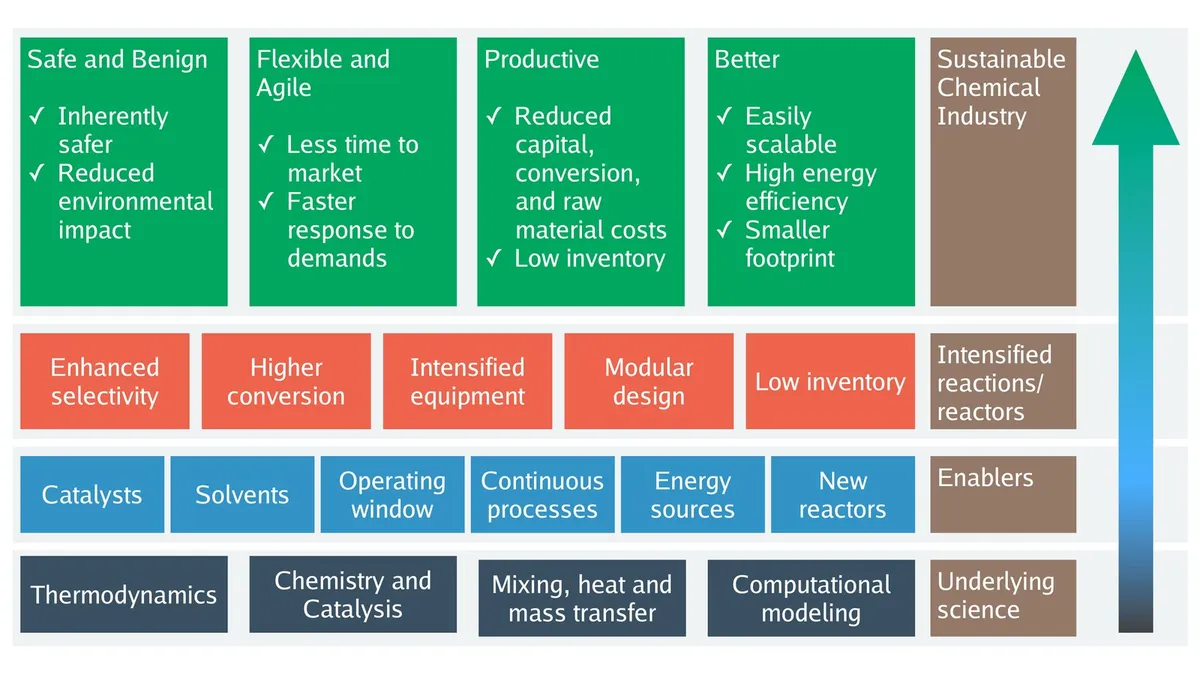
Many of the reactors that make fuels, chemicals and materials are limited not by chemistry but by transport: how fast heat, mass and mixing can be delivered. Intensification attacks those limits directly, aiming for equipment that is safer, smaller, more flexible and more energy efficient.
The problem
Multiphase systems are hard to intensify because the flow decides performance. Uneven distribution creates hot spots and unused catalyst, poor phase contact limits conversion, and large equipment is costly to replace. Designers need a framework for choosing a strategy, and validated models to test a design before building it.
What we do
- Strategies and framework. Review ways to intensify gas-liquid, gas-solid and three-phase systems, such as structured internals, spinning disc and oscillatory baffled reactors and acoustic enhancement, and explain the physics behind each.
- Additive manufacturing. Design 3D-printed flow distributors that deliver highly uniform flow to many channels.
- Retrofit reactor design. Study methanol synthesis reactors in which metal inserts move catalyst closer to the cooling surface for near-isothermal operation. In the published work, methanol yield rose by an average of 36% in tube-cooled reactors and 27% in tubular reactors.
- Gas-solid processes. Show how better command of gas-solid flow (fluidisation, risers, cyclones) enables process innovation.
Approach
Validated CFD, backed by experiments, is the common tool. We use it to understand the flow, test intensified geometries and screen options before fabrication. We are also exploring a Coanda-effect crystallizer as an early-stage concept; it has not yet produced published results.
Outputs
- Intensifying Multiphase Reactions and Reactors: Strategies and Examples
- Additively Manufactured, Highly-Uniform Flow Distributor for Process Intensification
- Intensified Isothermal Reactor for Methanol Synthesis
- Enabling process innovations via mastering multiphase flows: Gas–Solid processes
- Multiphase flows and process industries
Collaborators
Curtin University, RMIT University, Queen’s University Belfast and the University of Limerick.
Contact
For collaboration or student projects on reactor intensification, additive manufacturing of process equipment or multiphase CFD, contact the SMILE lab.